
Claude Opus 5.5 or GPT‑6 Sol? Top-tier AI just got cheaper, and what that means for your business
On 22 September, Anthropic released Claude Opus 5.5 and OpenAI released GPT‑6 Sol, on the same day and barely three weeks after Claude Fable 5.1 and GPT‑6 Astra. What the two new models have in common is that they make top-tier quality cheaper: work that used to need the most expensive model now costs less. We look at each one separately, compare them using a real-world test, and explain what it means for a business.
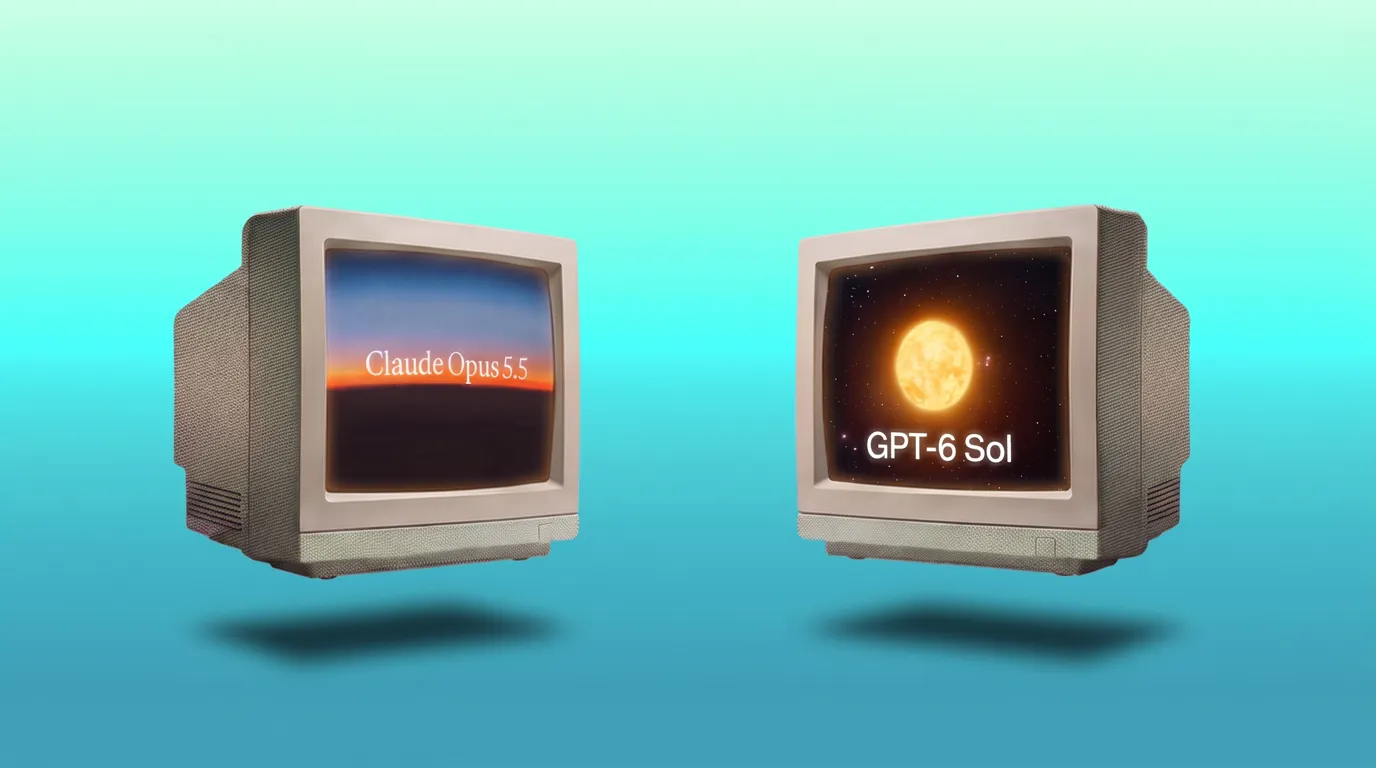
22 days, four frontier models
Claude Fable 5.1 arrived on 1 September, GPT‑6 Astra two days later, and on 22 September Opus 5.5 and GPT‑6 Sol came out on the same day. That is four frontier models in three weeks, and the pace is not slowing down.
There is an interesting tension here. A week before the launch, Anthropic's CEO, Dario Amodei, argued that AI progress should be paced so that safety practices keep up with model capabilities. Opus 5.5 is Anthropic's first release since that call. The race continues, but the emphasis has shifted: both companies made top-tier quality cheaper and faster.
Claude Opus 5.5: Fable-level work at a lower price
Opus has always been Anthropic's cheaper line compared with Fable. For the new version, the company says it performs at the level of Fable 5.1 on most work, and at default settings a typical task costs 40% less than with Opus 5.
The savings come from two places. The token price dropped by 20%: $4 per million input tokens and $20 per million output tokens, down from Opus 5's $5 and $25. The rest comes from needing fewer tokens for the same work. For comparison, Fable 5.1 and GPT‑6 Astra both cost $10 and $50. Opus 5.5 also generates output more than 30% faster than Opus 5.
The model is available on all of Anthropic's platforms, and on Amazon, Google and Microsoft's clouds as well as the developer API. With the launch, Anthropic also raised the five-hour usage limits on the Pro, Max, Team and seat-based Enterprise plans.
In an internal Anthropic test, the models had to write a report on a company's quarterly results, and a single invented figure or quote meant failure. 16 of Opus 5.5's 18 reports passed; Fable 5.1 and Opus 5 never passed.
In another test, the models analysed a merger between two fictional software companies, building an Excel model and then an executive presentation. Opus 5.5 finished in 63 minutes versus 93 for Opus 5, at half the cost.
According to Anthropic, it puts the most important information up front, uses less jargon, and follows the writing rules you give it, which makes it a better partner over longer sessions.
One early tester completed a 680,000-line code migration with it in less than a day. According to Anthropic, that would have taken an engineering team weeks.
GPT‑6 Sol: much of Astra's capability at a lower price
The GPT‑6 family now has three members. OpenAI's own guidance is to start with Astra for the hardest, most complex work, choose Sol to balance capability and cost, and use Luna for high-volume tasks with a clear goal, such as summarising documents or extracting information. Per million tokens, Astra costs $10 and $50, Sol $2 and $10, and Luna $0.10 and $0.50.
Sol costs half as much as its predecessor, GPT‑5.6 Sol. OpenAI says GPT‑6 Astra introduced a new generation of intelligence, and these models make it more efficient and accessible. According to TechCrunch, Sol makes about half as many mistakes as its predecessor. OpenAI positions it mainly for complex coding and agentic work, where the model carries several steps through on its own.
One thing is easy to mix up: in the GPT‑5.6 family, Sol was the flagship, but in the GPT‑6 family Astra is at the top and Sol sits in the middle. The same name no longer means the same position.
Sol is available in ChatGPT Work and Codex for Plus, Pro, Business, Enterprise and Edu users, and in the API. Free and Go users can try Luna in the desktop app.
Opus 5.5 or GPT‑6 Sol? Lessons from a real-world test
After the launch, one tester compared the two models on ten real tasks with identical instructions, running Opus 5.5 in Claude Code and Sol in Codex. It is one person's experience, not a lab benchmark, but it shows clearly how the two models differ in character.
The result was 7:1 for Opus 5.5, with two tasks not counted. By the tester's tally, however, Opus cost roughly three times as much ($213 versus $74) and took longer overall (8 hours 40 minutes versus 5 hours 51 minutes).
- Website: Opus built a more premium page with a stronger hero and layered animations, at roughly three times the cost; Sol's page was simpler.
- Video and reels: Opus delivered energetic edits with music, sound effects and good pacing; Sol's reel had no music, a humming background noise and few animations.
- Browser work: Opus built an online course faster and cheaper and handled a drawing task well; Sol assembled the course well, but on the drawing task it first generated an image instead of drawing, and the retry was weak.
- Code fixing: here Sol won, scoring 100 out of 100 against Opus's 97, at roughly a twentieth of the cost, although it stopped halfway for safety reasons and had to be restarted.
The tester also noticed that Sol asks clarifying questions more often, which sharpens the request but can slow down independent work. Their suggestion: let Opus 5.5 run the job and hand well-defined subtasks to several Sol agents with precise instructions, so each model works where it adds the most value.
What to watch out for
The token price is not the full price. Opus 5.5 costs twice as much per token as Sol, yet in the test it cost about three times as much, because it did more work and used more tokens. Always look at what a completed task costs, not just the list price.
The strongest setting is not always worth it. Both models let you set how much they "think" about a task. According to Anthropic, at its default setting Opus 5.5 beats GPT‑6 Astra at maximum effort on a coding test, for about a fifth of the cost. Start at the medium level and only go higher where you can see the difference.
If several AI agents work at once, keep them apart. Two tasks in the test did not count because the two models worked in the same folder and overwrote each other's files. When you run agents in parallel, tell them not to touch each other's work, or give each its own folder.
Mind the cybersecurity limits. Because Opus 5.5 is very strong in biology and cybersecurity, Anthropic released it with stricter safeguards: most cybersecurity requests are automatically routed to an older model, Opus 4.8. Debugging your own code still works, but for a firm that specialises in security audits this matters.
What this means for small and mid-sized businesses
Both announcements say the same thing: what needed the most expensive models three weeks ago is now available for less. That can make tasks worthwhile that used to be too expensive to do with AI, such as regular reporting, processing large volumes of documents, or the first draft of client-facing analysis.
At this pace, though, it does not pay to build on a single model. A new one arrives every few weeks, and today's best value may not be tomorrow's. We recommend giving work that needs judgment, polished output and client-ready quality to a stronger model such as Opus 5.5, and well-defined, high-volume tasks to a cheaper one such as Sol or Luna. In a good setup the models are interchangeable, and the decision comes from testing on your own tasks, not from the announcements.
Want to know which model gives your processes the best results at the lowest cost? Let's look at it together in a free 30-minute consultation.
Free 30-minute consultationFrequently asked questions
What is the difference between Claude Opus 5.5 and GPT‑6 Sol?
Opus 5.5 is Anthropic's new model, which according to the company performs at the level of Fable 5.1 on most work, at a much lower price. GPT‑6 Sol is the middle tier of the GPT‑6 family: cheaper than Astra and built to balance capability and cost. In a ten-task real-world test, Opus 5.5 produced better results on most tasks, while Sol cost roughly a third as much.
How much do Claude Opus 5.5 and GPT‑6 Sol cost?
On the developer API, Opus 5.5 costs $4 per million input tokens and $20 per million output tokens; GPT‑6 Sol costs $2 and $10. In the subscription apps, usage counts toward your plan's limits.
Should you switch models now?
Not blindly. Try the new models on your own tasks and look at the cost per task. Opus 5.5 suits work that needs judgment; for well-defined, high-volume tasks the cheaper Sol or Luna may be enough.
Where are the two models available?
Opus 5.5 is available on all of Anthropic's platforms and with the major cloud providers. GPT‑6 Sol is available in ChatGPT Work and Codex on paid plans and in the API; free users can try Luna.
Sources
- Anthropic: Introducing Claude Opus 5.5
- Claude Docs: Claude Opus 5.5
- OpenAI Developer Community: Announcing GPT-6 Sol and GPT-6 Luna in the API, Codex and ChatGPT
- OpenAI API: Models
- OpenAI API: GPT-6 Sol
- TechCrunch: OpenAI launches GPT-6 Sol and Luna
- MacRumors: Anthropic launches Claude Opus 5.5
- 9to5Mac: OpenAI upgrading ChatGPT and Codex with two more GPT-6 models
Last updated: